
Choosing reliable hosting goes far beyond finding the lowest price. The right provider can directly influence site speed, visitor experience, ease of management, and even SEO results.
Among the most popular options on the market are Hostinger and Namecheap. Both offer shared hosting, free SSL, one-click WordPress installation, and 24/7 support. However, when we analyze infrastructure, performance, and features included in the plans, the differences begin to become clearer.
In this Hostinger vs Namecheap comparison, we will examine the main points that really matter for those planning to create a blog, business site, online store, or affiliate project in 2026.
Hostinger vs Namecheap Comparison: Quick Overview
Both Hostinger and Namecheap offer reliable hosting services, but they differ in performance, features, and ease of use. The table below highlights the main differences between the two providers.
| Feature | Hostinger | Namecheap |
|---|---|---|
| Control Panel | hPanel | cPanel |
| Storage Type | NVMe SSD | SSD |
| Managed WordPress | Yes | EasyWP |
| Free SSL | Yes | Yes |
| Free Domain | Yes (on annual plans) | Available on selected plans |
| Free Migration | Yes | Yes |
| Automatic Backups | Yes | Yes |
| Uptime Guarantee | 99.9% | 99.9% |
| Beginner-Friendliness | Excellent | Good |
Although both companies are highly rated, Hostinger has been heavily investing in modern technologies focused on performance and WordPress site optimization.
Ease of Use: Which Hosting Provider Is Better for Beginners?
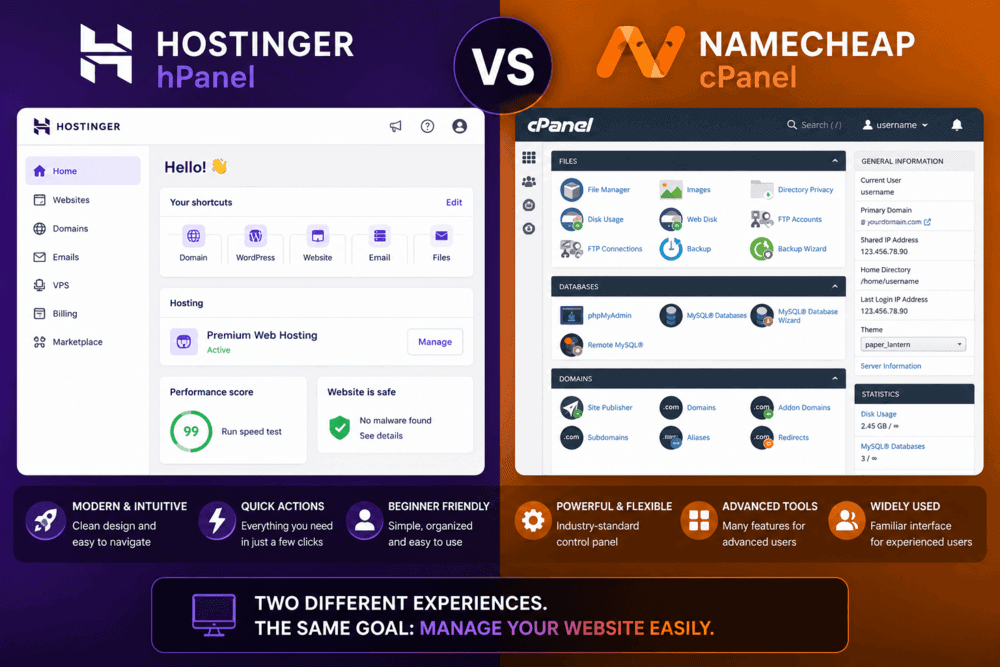
One of the first differences noticed by users is the management panel.
Hostinger uses hPanel, a proprietary platform created to simplify common tasks such as installing WordPress, configuring email, managing domains, and restoring backups. The interface is clean, organized, and easy to understand even for those who have never managed a hosting account before.
Namecheap, on the other hand, uses the traditional cPanel. This is an extremely popular and comprehensive tool, widely used by website hosting providers around the world. More experienced users tend to like cPanel for its flexibility, but beginners may take a bit longer to become familiar with all the available options.
For those creating their first website, Hostinger’s experience is usually more intuitive.
hPanel offers a more modern and user-friendly experience without sacrificing advanced management features.
Performance, Speed, and Response Time
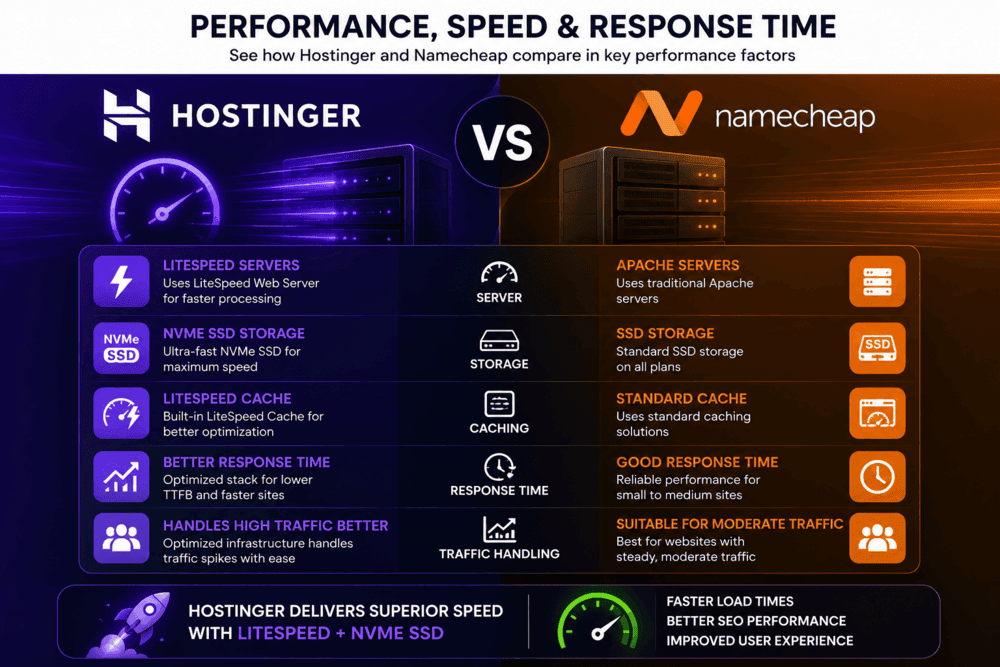
Loading speed is one of the most important factors for any website. Besides affecting visitors’ experience, it also influences key SEO and conversion metrics.
Hostinger uses LiteSpeed servers combined with NVMe SSD storage. This combination enables faster server responses, better traffic handling, and more efficient loading of dynamic pages.
Namecheap uses traditional SSD storage in its shared plans. While the performance is sufficient for many projects, it does not offer the same benefits as the LiteSpeed + NVMe combination found at Hostinger.
Another important differentiator is native integration with LiteSpeed Cache, one of the most efficient caching plugins for WordPress.
In practice, users running blogs, content sites, or online stores tend to notice more consistent speed gains with Hostinger.
The combination of LiteSpeed servers and NVMe SSD storage provides a clear performance advantage.
Hostinger vs Namecheap: Which WordPress Hosting Is Better?
If your project uses WordPress, it’s worth examining the specific features offered by each company.
Hostinger includes tools such as automatic updates, built-in caching, free migration, and AI-powered website creation tools.
Namecheap offers EasyWP, a managed WordPress hosting solution designed to simplify maintenance and update tasks.
While EasyWP is an interesting alternative for those who want a more streamlined experience, Hostinger offers a broader set of features directly integrated with hosting.
For bloggers, content creators, and affiliates, this means less dependence on external tools and easier management.
The platform provides a more complete environment for growing WordPress projects.
Hosting Plans and Technical Features
When comparing the most popular plans of the two companies, some important differences become evident.
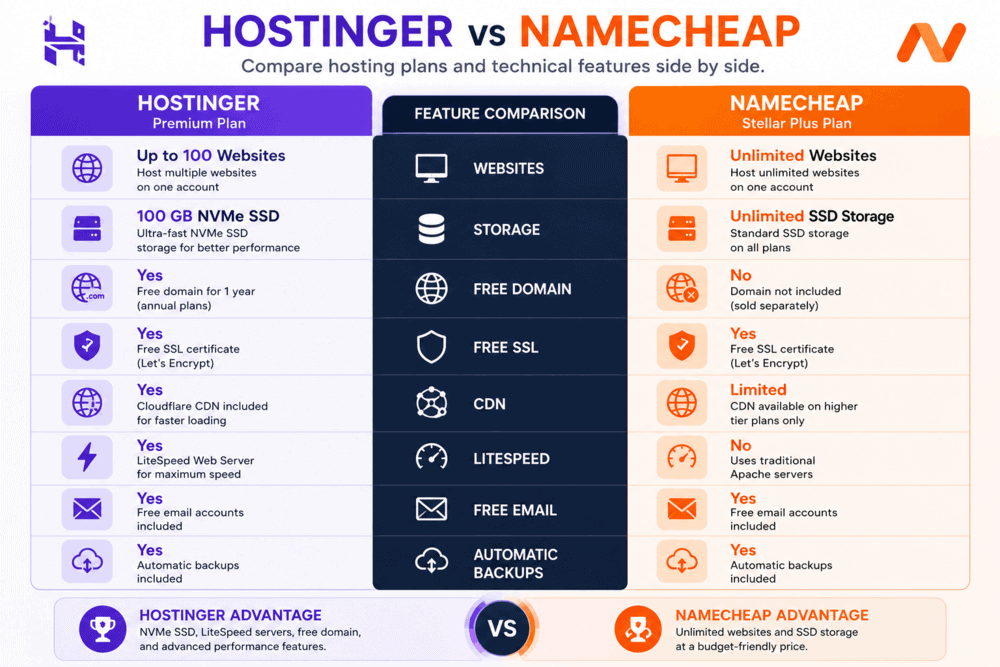
In practice, the main difference lies in the technology used. Although Namecheap offers unlimited SSD storage on some plans, Hostinger relies on NVMe SSD storage and LiteSpeed servers. For WordPress blogs, online stores, and sites with growing traffic, these technologies usually deliver noticeable improvements in response time.
For projects that depend on consistent performance, such as content blogs, online stores, and affiliate sites, Hostinger’s combination of LiteSpeed and NVMe storage represents a significant long-term advantage.
Security
Today, any reliable hosting must offer basic protection features.
Both Hostinger and Namecheap include:
- Free SSL certificate
- DDoS protection
- Security monitoring
- Account isolation
The difference lies in how these features are integrated into the hosting environment.
Hostinger offers a more automated experience, including simplified backup management and additional tools aimed at WordPress sites. Hostinger also provides integrated tools that simplify day-to-day website management.
The protection is easier to manage for users without advanced technical knowledge.
Backup System
Automatic backups can prevent hours of lost work after failures, configuration errors, or security issues.
Hostinger offers automatic weekly backups on basic plans and daily backups on more advanced plans.
Namecheap also provides backups, but the frequency and restoration features vary depending on the service purchased.
For those who value convenience and predictability, Hostinger’s backup policy is usually simpler to understand and use.
The backup strategy is more consistent for most users.
Customer Support
Both Hostinger and Namecheap offer 24/7 support.
Both companies provide comprehensive knowledge bases, detailed documentation, and live chat support, which is expected from any leadingweb hosting provider.
In practice, both have a good reputation when it comes to technical support.
Both providers offer efficient channels for problem resolution and customer support.
Prices and Value for Money
When looking only at the initial promotional price, Namecheap usually offers lower prices.
On the other hand, Hostinger includes technologies like LiteSpeed, NVMe SSD storage, and various WordPress optimizations without requiring upgrades to higher plans.Hostinger plans therefore tend to deliver stronger overall value.
Therefore, the choice depends on what you value more.
If the goal is to spend as little as possible initially, Namecheap can be attractive. If the focus is on performance and included features, Hostinger tends to offer more value for the investment.
Hostinger vs Namecheap: Key Differences
Although both providers offer reliable hosting services, they focus on different priorities. Hostinger emphasizes performance, WordPress optimization, and ease of use, while Namecheap stands out for its lower entry pricing and traditional cPanel environment. This Hostinger vs Namecheap comparison highlights the areas where each provider excels.
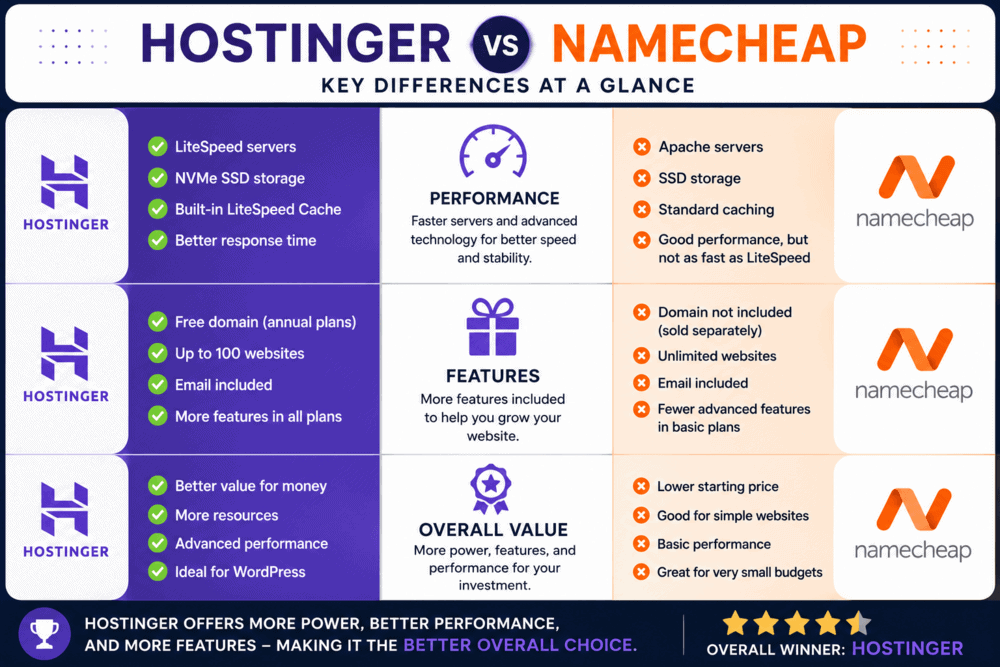
Overall, Hostinger stands out in more categories, particularly in performance, WordPress optimization, and long-term value.
Who Should Choose Hostinger?
Hostinger is a better fit for users who plan to expand their projects over time.
Features like LiteSpeed, NVMe SSD storage, and WordPress-specific optimizations help maintain good performance even as traffic grows.
Content blogs, affiliate sites, and small businesses often benefit more from Hostinger because the platform combines solid performance, ease of management, and WordPress-focused features.
Who Should Choose Namecheap?
Namecheap can be a good alternative for those looking for a lower initial cost or who already use the company as their domain registrar.
Its cPanel-based environment also remains attractive to users who prefer a traditional interface and already have experience with shared hosting.
Hostinger vs Namecheap: Which Has More Advantages?
After analyzing performance, features, security, ease of use and value for money, the table below summarizes the main points of the comparison.
| Feature | Hostinger | Namecheap | Winner |
|---|---|---|---|
| Speed | ⭐⭐⭐⭐⭐ | ⭐⭐⭐⭐ | 🏆 Hostinger |
| WordPress | ⭐⭐⭐⭐⭐ | ⭐⭐⭐⭐ | 🏆 Hostinger |
| Storage | NVMe SSD | SSD | 🏆 Hostinger |
| Security | ⭐⭐⭐⭐⭐ | ⭐⭐⭐⭐ | 🏆 Hostinger |
| Backups | ⭐⭐⭐⭐⭐ | ⭐⭐⭐⭐ | 🏆 Hostinger |
| Ease of Use | ⭐⭐⭐⭐⭐ | ⭐⭐⭐⭐ | 🏆 Hostinger |
| Support | ⭐⭐⭐⭐⭐ | ⭐⭐⭐⭐⭐ | 🤝 Tie |
| Starting Price | ⭐⭐⭐⭐ | ⭐⭐⭐⭐⭐ | 🏆 Namecheap |
| Value for Money | ⭐⭐⭐⭐⭐ | ⭐⭐⭐⭐ | 🏆 Hostinger |
🏆 Our Choice: Hostinger
If you’re looking for fast hosting optimized for WordPress and excellent value for money, Hostinger offers the most complete set of features for most projects.
✓ LiteSpeed Web Server
✓ NVMe SSD Storage
✓ Free domain on annual plans
✓ Best performance for WordPress
✓ Best overall value for money
Both providers are well-established companies in the hosting industry and are capable of supporting websites of different sizes. The best choice ultimately depends on your budget, technical preferences, and long-term goals.
Hostinger or Namecheap: Which Is the Better Choice in 2026?
Namecheap remains an interesting alternative for users seeking the lowest initial price and who prefer to work with the traditional cPanel. For small projects, personal sites, or users who prioritize only the lowest initial cost, Namecheap can be a perfect fit.
However, when we analyze performance, technologies used, WordPress features, and the value delivered by the plan, Hostinger presents a more complete offering.
For bloggers, affiliates, content creators, and small businesses that depend on speed, SEO, and scalability, Hostinger provides a consistent advantage thanks to LiteSpeed servers, NVMe SSD storage, and integrated WordPress tools. For these users, Hostinger is the better choice.
In short, the Hostinger vs Namecheap comparison shows that Namecheap wins on initial price, while Hostinger stands out in performance, features, and overall value for money, making it the better choice for most users in 2026.
Hostinger vs Namecheap FAQ
Is Hostinger faster than Namecheap?
Yes. Hostinger uses LiteSpeed servers and NVMe SSD storage, technologies that typically deliver better performance than traditional shared infrastructure.
Is Namecheap good for WordPress?
Yes. In addition to shared hosting plans, the company offers EasyWP, a platform built specifically for WordPress sites.
Which offers better value: Namecheap vs Hostinger?
For most users, Hostinger offers better value due to its combination of performance, included features, and ease of use. When comparing Namecheap vs Hostinger, Hostinger stands out thanks to LiteSpeed servers, NVMe SSD storage, and built-in WordPress optimizations.
Can I migrate my site for free?
Yes. Both Hostinger and Namecheap offer free migration options on certain plans and services.
Which provider should I choose between Namecheap and Hostinger?
The choice between Namecheap and Hostinger depends on your priorities. If you prefer lower upfront costs and a traditional cPanel environment, Namecheap can be a good option. However, if performance, WordPress features, and long-term value are more important, Hostinger is generally the stronger choice.
Hostinger or Namecheap for affiliates?
For affiliate sites and SEO-focused projects, Hostinger tends to deliver better results due to the use of LiteSpeed and NVMe SSD storage.
Hostinger or Namecheap: which is better for SEO?
Although SEO depends on many factors, Hostinger offers advantages related to loading speed thanks to LiteSpeed servers and NVMe SSD storage, features that can contribute to better user experience metrics.
Does Namecheap offer a free domain?
Some promotional plans include a free domain, but this may vary depending on the offer available at the time of purchase.